
Replacement dairy heifers must be managed as an investment, not a cost. Knowing how to manage them is key to maximizing profit and replacement heifer quality.
For many years, dairy producers have measured the cost of a replacement heifer with a simple calculation: daily raising cost multiplied by days to calving, compared with the price of a springer. That arithmetic still has value, but it ignores two things: the beef value of the animal and the market opportunities a replacement pregnancy competes against. When calf values were low, ignoring those costs was acceptable and simplified the math. They are no longer low.
A dairy must instead look at the whole pipeline: the opportunity cost of producing one type of calf over another, death losses, purpose conversion (a dairy heifer redirected to meat) and the final beef sale as a cull cow. At birth, a heifer already has market value. From that point on, every day of feed, labor, housing and management is capitalized investment made before she can produce any milk. If she freshens and stays in the herd, that investment supports future performance. If she dies, fails to breed, loses a pregnancy, calves too late or leaves early in first lactation, much of it is lost.
Put another way, the dairy manager must act as a CFO. Raising expenses are not expenses; they are capitalized investment. The only true costs are death, which returns $0 on that investment, and purpose conversion to beef before first calving. After first calving, the asset amortizes, with milk value offsetting the amortization, and the cull-cow check finally realizes what the animal truly cost. The difference in the cost of raising calves for dairy versus beef, we refer to as excess investment.
This changes the question. It is not enough to ask what it costs to raise a heifer to calving; the better question is whether the program gives the herd enough high-quality animals to make profitable decisions. Profitable heifer management means maximizing beef income and balancing amortization of replacements with income over feed cost.
The replacement market has changed the calculation
The current beef market has raised the stakes. Beef-on-dairy means a dairy replacement pregnancy now competes with a real calf-market alternative, and tight inventories have made being short of heifers more expensive. CoBank reports that U.S. dairy replacement inventories are at a 20-year low, with beef semen use and strong beef prices driving the shift.
High calf and beef prices drive all of this. The replacement-cost calculator below helps a producer see the cost of death and of converting virgin heifers to beef. The calculator will always show a lower replacement cost when every heifer goes to dairy, but that is where the manager must decide how many impaired heifers to keep in the milking herd and at what price. Keeping cull rates very low lowers replacement cost on paper, yet higher death loss or poorer milk production carry real costs of their own.
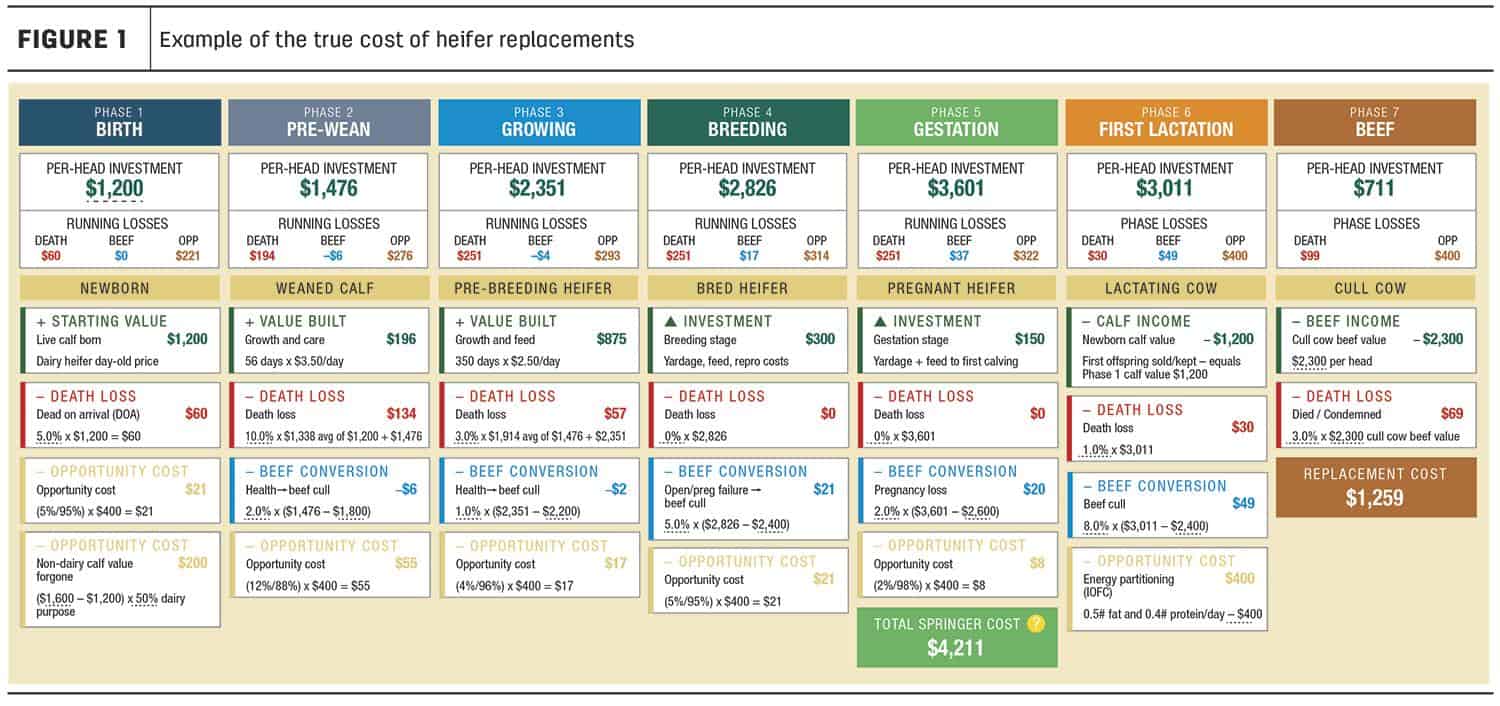
In Figure 1, a dairy has $2,400 per head invested in a heifer (yardage, feed, trucking, breeding), gets a calf that replaces her initial value and sells cull cows averaging $2,300. Simple math says the replacement costs $100, or, ignoring cull value, $2,400 with beef checks treated as a bonus from thin air. The true cost is $1,259: $420 per head for death loss and its opportunity cost over an average lifetime, $190 per head for converting 10% of heifers to beef before first calving, the opportunity cost of choosing a dairy heifer over a higher-priced beef calf and the cost of a first-lactation cow milking at lower components while she matures. This dairy gets 77% of live-born dairy heifers to first freshening.
The hidden cost of being short on replacements is paid through higher purchase costs, weaker culling decisions, slower genetic progress and extra days carried by cows that should already have left the herd.
Replacement planning should therefore begin with the number of fresh heifers that produces the best milking herd, a number shaped by cow turnover, pregnancy losses, heifer survival and first-lactation retention. A farm that needs 3,000 fresh heifers cannot simply aim for 3,000 heifer calves; it needs enough pregnancies and calves to absorb the normal losses before a heifer becomes a productive cow, plus enough margin to convert the weakest candidates to beef.
Daily raising cost is only the beginning
Daily raising cost remains a useful starting point. A heifer that costs $3 per day and calves at 730 days carries $2,190 in direct raising cost; a 60-day delay adds another $180 before she gives any milk. That extra investment can still pay off if the delay buys size that protects later lactation. The mental model is beef production plus the excess investment needed to maximize milk, investment returned through beef sales and amortization during lactation.
Maturity still has to come first
Age at first calving is a useful benchmark but misleading on its own. A 22-month-old heifer at the right size is not the same economic animal as a 22-month-old that is short of frame, weight or condition.
UW–Madison Extension guidance puts the emphasis on maturity as well as age. It describes breeding targets around 55% to 60% of mature bodyweight, pre-calving weight around 90% to 94% of mature bodyweight and post-calving weight around 80% to 84% of mature bodyweight.
Optimizing this per animal to hold investment down meaningfully reduces the amortization carried into lactation. The aim is the earliest profitable calving age: a heifer large enough, healthy enough and likely enough to stay in the herd to justify her place.
The lactating herd pays for the replacement program
Dr. Mike Overton, global dairy platform lead at Zoetis, and Dr. Steve Eicker, vice president and owner at VAS, frame replacement decisions around opportunity cost, cow performance and heifer quality rather than a replacement cost to minimize in isolation. By the time a heifer enters the milking herd, much of her cost is already sunk, so the forward-looking question is not whether she repays her raising bill but whether she is a better use of a stall than the cow she would replace. That is why a strong replacement pipeline matters: It lets lower-profit cows leave when they should, while the goal stays having enough good heifers ready when the herd needs them, not the cheapest heifers or the most of them.
Know where value is being lost, and act on it
Death loss, disease, reproductive failure and early culling are usually discussed as performance measures. They are also financial events. In the example above they made up half of the replacement cost that must be repaid during lactation.
Research supports tracking these losses by stage. A large Holstein study showed mortality and culling risk varies by age, with digestive, respiratory and reproductive issues among the major causes. That same information should guide removal decisions. Not every heifer that falls behind is a total loss; one with poor growth, repeated health events or failure to conceive may no longer belong in the dairy pipeline yet still hold beef value. The point is to make that call early with the minimum excess investment. In the example above, converting 10% of heifers to beef costs 21 cents per head per day in amortization of replacement, a cost the best 90% of replacements must make up. The earlier the decision, the less excess investment is sunk and the better the chance to use growth implants for beef.
Build decision points throughout the program. Poor growth before breeding, failure to reach target weight, repeated respiratory disease, delayed conception or pregnancy loss should trigger a review.
Beef-on-dairy makes opportunity cost visible
Beef-on-dairy has made the opportunity cost of creating a replacement clearer, and harder. When black-hide beef-cross calves are worth hundreds more than dairy heifers, the opportunity cost of each replacement, and the excess investment in it, rises.
The best strategy is neither to make the most dairy heifers nor to maximize beef semen use. It is to make the most economically sound decision given your calf and beef markets and the herd’s need for high-value replacements.
The better replacement question
The strongest replacement programs are not built around a single average cost. They are built on well-managed dairies that keep choices open, able to set the economically ideal cow replacement rate and to convert underperforming heifers to beef. Having levers to pull, and understanding the real economic consequence of pulling each one, is the key to the right decision on your dairy.
This article by David Cook and Peter Jackson was originally published August 10, 2026 by AgProud / Progressive Dairy. References omitted but are available upon request by emailing the editor.